吊装带完整使用禁忌 Complete Prohibitions for Lifting Sling Use
一、载荷与受力禁忌
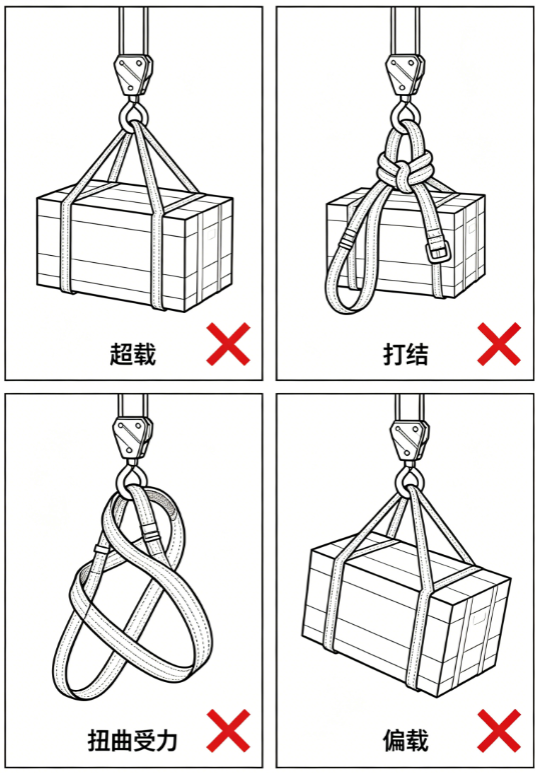
严禁超载:不得超过吊带上标注额定载荷;多根吊装夹角<60° 时载荷会成倍放大,禁止不换算直接起吊。
禁止冲击、猛拉、急刹:瞬间冲击力可达静载 2~5 倍,易拉断吊带;禁止快速甩动、抛吊货物。
禁止打结、扭绞、拧麻花:打结会使强度下降 50% 以上,应力集中断裂;禁止打结接长吊带、吊钩上缠绕栓结固定货物。
禁止扭曲受力:全程保证带体平整,扭转后受力仅局部纤维承重。
禁止单根偏载、受力不均:多根同吊时规格、材质、长度要一致,不同吨位 / 材质吊带严禁混用。
禁止长时间悬空吊载:重物长期压在吊带上会造成纤维拉伸损伤。
二、尖锐、棱角、摩擦禁忌
严禁无护具直接吊尖角、毛刺、锐边工件:钢板、型材、铸件棱角要加装护角、橡胶护套,否则直接割破织带报废。
禁止地面拖拽吊带 / 重物:粗糙地面、钢筋、焊渣会快速磨断表层纤维。
重物压住吊带时,禁止强行抽拉:需抬升货物再取出,避免撕裂带体。
软环禁止挂带尖角、锋利边缘吊钩:吊钩棱角切割缝合环眼,钩尖不得受力。
三、环境与温度禁忌(涤纶 / 丙纶通用)
高温禁用:涤纶吊带长期>100℃、瞬时接触焊渣、明火、热工件直接报废;焊割作业附近禁止使用普通吊带。
化学品腐蚀严禁使用
涤纶吊带:严禁强碱(烧碱、水泥浆、强碱清洗剂);弱酸短期可用,事后清水冲洗。
丙纶吊带:耐酸碱但不耐高温、紫外线暴晒。
禁止长期暴晒存放:紫外线会加速纤维老化变脆,强度大幅衰减。
禁止在强电流、易燃易爆高危区域使用:防止火花灼烧吊带,化纤燃烧产生毒烟。
低温:常规合成吊带低于 - 40℃禁止使用,纤维变硬易脆断。
四、设备与操作方式禁忌
禁止用吊带吊运人员,严禁吊装易燃易爆、强腐蚀危化品。
禁止用吊带捆绑、拖拽车辆、设备做牵引绳。
带宽>75mm 扁平吊带,禁止直接软环挂吊钩,需搭配卸扣过渡,防止撕裂缝合处。
禁止无护垫直接绕过钢棱、滚筒、窄支点,窄支点会挤压切断织带。
禁止敲击、重物砸压吊带,内部纤维隐形断裂。
五、产品本身禁用(出现以下直接报废,严禁继续使用)
带体割伤、穿孔、切口、穿透破损、大面积起毛断丝;
缝合线开裂、脱线、环眼破损;
纤维硬化、发脆、变色老化、腐蚀、受热融化痕迹;
受力后局部发白、拉长、变薄;
标识标签缺失、模糊看不清额定载荷;
非标白色丙纶吊带(无国标吨位标准,虚标严重,工地明令禁用)。
六、存放、修补禁忌
破损吊带严禁自行缝合修补,修补无法恢复原有强度,要报废。
禁止与钢丝、尖锐工具混放摩擦;禁止堆压重物长期挤压吊带。
禁止存放于热源、酸碱、油污、潮湿腐蚀区域。
I. Load & Force‑Bearing Prohibitions
No Overloading: Never exceed the rated working load marked on the lifting sling. When the included angle of multi‑leg slings is less than 60°, the actual tension will multiply. Do not commence lifting without corresponding load recalculation.
No Shock Loading, Violent Pulling or Sudden Braking: Instant impact force can reach 2‑5 times of static load, which may rupture the sling. Rapid swinging and throwing of loads are prohibited.
No Knotting, Twisting or Tangling: Knots reduce sling strength by over 50% and cause fracture due to stress concentration. Do not extend slings by knotting, nor fasten cargo by looping and tying slings on hooks.
No Distorted Loading: Keep the sling body flat throughout operation. Twisted slings will bear load only on partial fibers.
No Eccentric or Uneven Loading for Single‑Sling Lifts: For multi‑sling hoisting, slings shall be of identical specification, material and length. Never mix slings of different tonnages or materials.
No Long‑Term Suspended Loading: Permanent weight pressing on the sling will cause irreversible fiber stretch damage.
II. Prohibitions against Sharp Corners, Edges and Friction
Never lift workpieces with sharp corners, burrs or sharp edges without protective accessories: Protective corner guards or rubber sleeves must be fitted for steel plates, profiles and castings; otherwise the webbing will be cut and condemned.
Do not drag lifting slings or heavy loads on the ground: Rough ground, steel bars and welding slag will rapidly abrade surface fibers.
Do not forcibly pull out a sling trapped under heavy loads: Lift the cargo first to free the sling, to avoid tearing the webbing.
Do not fit soft loops onto hooks with sharp or cutting edges: Hook corners may cut sewn eyes; hook tips shall not sustain load.
III. Environmental & Temperature Prohibitions (Applicable for Polyester / Polypropylene Slings)
Forbidden under high‑temperature conditions: Polyester lifting slings shall not be used for long‑term service above 100 ℃. Direct contact with welding spatter, open flame or hot workpieces will render slings unfit for service. Ordinary slings shall not be used near welding‑cutting operations.
Forbidden under chemical corrosion conditions
Polyester sling: Strictly avoid strong alkalis (caustic soda, cement slurry, strong‑alkaline cleaning agents). Short‑time exposure to weak acids is permissible, followed by thorough water rinsing.
Polypropylene sling: Resists acids and alkalis, but vulnerable to high temperature and ultraviolet sunlight.
No long‑term sun‑exposed storage: UV radiation accelerates fiber aging and brittleness, leading to sharp strength loss.
Forbidden in high‑risk zones with heavy electric current or flammable‑explosive hazards: Prevent sling burning by sparks; synthetic fibers produce toxic smoke upon combustion.
Low‑temperature restriction: Conventional synthetic lifting slings shall not be used below ‑40 ℃; fibers become rigid and prone to brittle fracture.
IV. Equipment & Operating‑Method Prohibitions
Never lift personnel with lifting slings. Hoisting of flammable‑explosive and heavily corrosive hazardous chemicals is forbidden.
Do not use lifting slings as tow ropes for binding or dragging vehicles and equipment.
For flat lifting slings with width over 75 mm, do not hang soft loops directly onto hooks. Use shackles for transition connection to prevent tearing of sewn joints.
Do not route slings directly over steel edges, rollers or narrow fulcrums without padding. Narrow fulcrums can squeeze and cut off the webbing.
Do not strike or hammer slings with heavy objects, which may cause invisible internal fiber breakage.
V. Conditions for Immediate Condemnation (Do NOT continue using slings with any of the following defects)
Webbing cuts, perforations, incisions, penetrating damage, extensive fuzzing and broken filaments;
Ruptured stitching, loose threads, damaged sling eyes;
Fiber hardening, brittleness, discoloration‑aging, corrosion, heat‑melting traces;
Local whitening, elongation or thinning after load application;
Missing or illegible marking labels with unreadable rated working load;
Non‑standard white polypropylene slings (without national‑standard tonnage specification, heavily falsified rating, strictly prohibited on construction sites).
VI. Storage & Repair Prohibitions
Damaged lifting slings shall never be self‑repaired by stitching. Repairs cannot restore original strength; such slings must be condemned.
Do not store together with steel wires or sharp tools to avoid friction damage. Do not stack heavy goods on slings for long‑term compression.
Do not store slings in areas with heat sources, acids‑alkalis, oil contamination, dampness or corrosive atmosphere.